
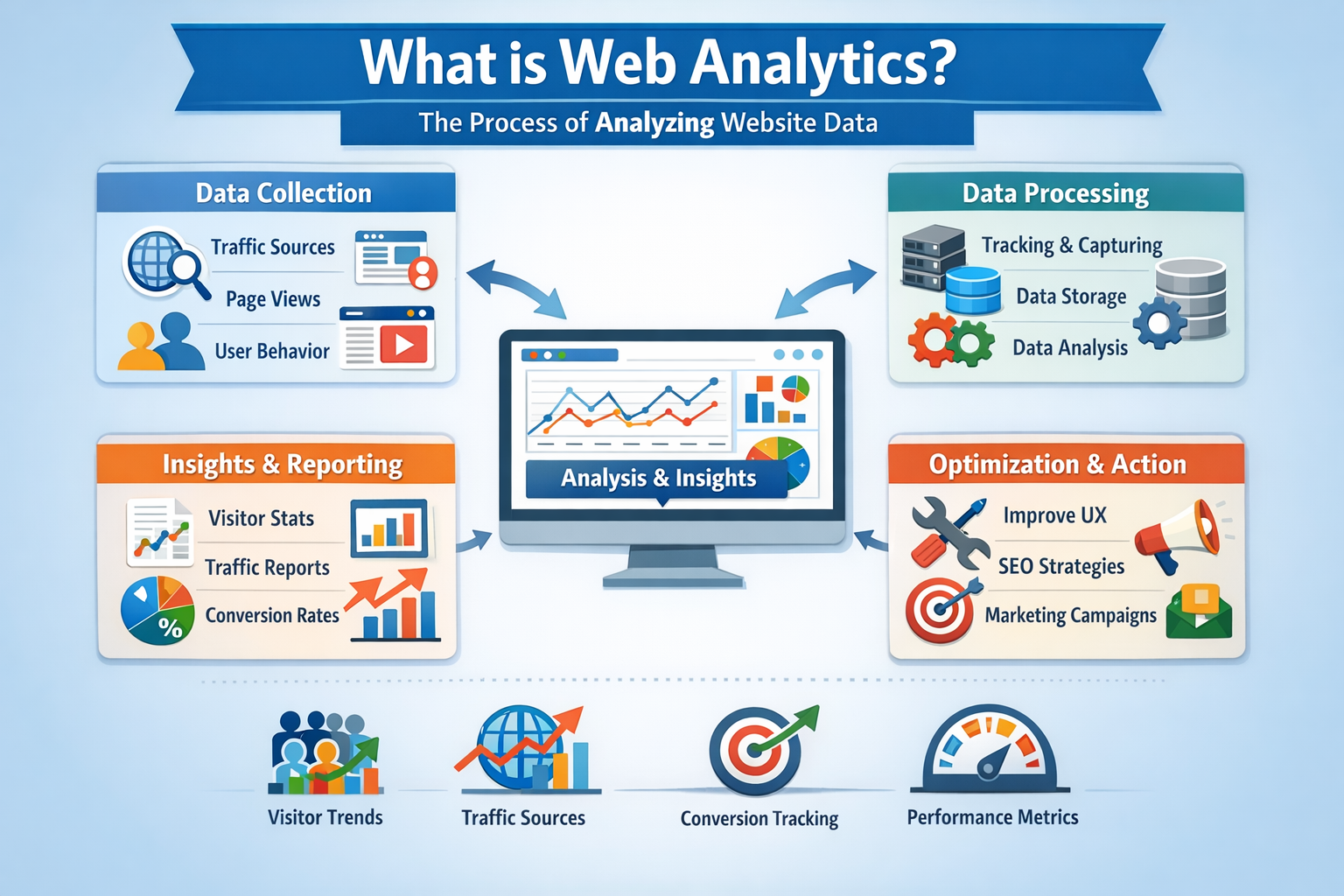
Website Analysis in Digital Marketing: A Practical Guide
A website is often the centre of a business’s digital marketing. It can introduce people to a brand, answer their questions and turn interested visitors into customers. But attracting visitors is only part of the job. To understand whether a website is helping meet business goals, marketers need to analyse how it performs and how people use it.
Website analysis brings together data about traffic, user behaviour, content, search visibility and technical performance. Used regularly, it helps businesses make informed improvements rather than relying on guesswork.
What is website analysis?
Website analysis is the process of reviewing a website’s performance and the behaviour of its visitors. It can reveal where people come from, which pages they visit, what actions they take and where they leave.
The purpose is not simply to collect numbers. It is to interpret them in the context of business objectives. For example, a high number of visits may look positive, but it has limited value if visitors cannot find relevant information or complete an important action.
Why website analysis matters in digital marketing
Digital marketing channels often direct people to a website, whether through search engines, social media, email or paid advertising. Analysis helps marketers understand how well that journey is working.
- It measures results: Businesses can assess whether campaigns are generating enquiries, sales, subscriptions or other valuable actions.
- It improves the user experience: Behaviour data can highlight confusing navigation, unhelpful content or pages where visitors struggle to proceed.
- It supports better decisions: Comparing performance over time helps teams prioritise changes that are likely to have the greatest impact.
- It strengthens search performance: Technical and content reviews can uncover issues that make pages harder for search engines and people to access.
- It helps allocate marketing budgets: Knowing which channels and landing pages contribute to business outcomes can inform future investment.
Key areas to assess
Traffic and acquisition
Start by understanding how visitors arrive at the website. Common sources include organic search, paid search, social media, email campaigns, referral links and direct visits.
Look beyond the total number of visitors. Consider whether each channel attracts the right audience and whether those visitors take meaningful actions. A smaller, highly relevant audience may be more valuable than a much larger group with little interest in the offer.
User behaviour
Behaviour data can show which pages visitors view, how they move through the site and where they leave. These patterns may point to opportunities for improvement, but they need careful interpretation. For instance, a short visit could mean a page failed to answer someone’s question—or that it answered it quickly.
Useful questions include:
- Which pages attract the most visits?
- Do visitors follow the intended path through the site?
- Where do people abandon forms, bookings or checkout processes?
- Are important pages easy to reach from the main navigation?
Conversions and business goals
A conversion is an action that matters to the business. It might be a purchase, an enquiry, a telephone call, a booking or a newsletter sign-up. The right actions depend on the organisation’s goals.
Set up conversion tracking for the actions that matter, then examine the whole journey—not just the final click. This can help identify whether a particular campaign, device or landing page contributes to successful outcomes.
Search engine performance
Search analysis looks at how a website appears in search results and whether its pages meet the needs behind relevant searches. Review which queries bring visitors to the site, which pages receive impressions and clicks, and whether the content clearly answers the searcher’s question.
Also check for issues such as missing page titles, duplicate content, broken links and pages that are difficult for search engines to crawl. Search performance should be assessed alongside the quality and usefulness of the content.
Technical performance and accessibility
A website needs to work reliably across different devices and connection speeds. Slow loading, layout problems, broken pages or inaccessible features can frustrate visitors and prevent them from completing tasks.
Assess page speed, mobile usability, security, navigation and accessibility. Check that text is readable, images have appropriate alternative text, forms can be used with a keyboard and important information is not conveyed through colour alone.
Choosing useful metrics
The most useful metrics are those connected to a clear objective. A few well-chosen measures are usually more helpful than a dashboard crowded with figures.
- Engagement: Page views, engaged sessions and interactions with key content.
- Acquisition: Visitors and conversions by marketing channel or campaign.
- Conversion: Completed purchases, enquiries, bookings or other defined actions.
- Search visibility: Impressions, clicks, click-through rate and average position for relevant queries.
- Technical health: Page speed, mobile usability, broken links and website errors.
Metrics should be read in context. Seasonality, campaign activity, changes to the website and shifts in audience behaviour can all affect results. Comparing equivalent periods and annotating major changes makes analysis more meaningful.
A simple website analysis process
- Define the goal. Decide what the website should achieve, such as generating qualified enquiries or increasing online sales.
- Check the tracking. Confirm that analytics and conversion events are set up correctly and that data is being recorded consistently.
- Review the audience and channels. Identify who is visiting and how they arrive.
- Examine key pages and journeys. Focus on pages that support important goals, such as product pages, service pages and forms.
- Look for problems and opportunities. Combine quantitative data with feedback, usability testing and direct observation.
- Prioritise changes. Consider potential impact, effort and available evidence before deciding what to address first.
- Test and review. Make changes, allow enough time to gather relevant data and compare the results with the original performance.
Common mistakes to avoid
Website analysis can be misleading when data is treated as an answer in itself. Avoid judging success by traffic alone, drawing conclusions from very small samples or making several changes at once without a way to assess their impact.
It is also important to check for measurement problems. Duplicate tracking, missing conversion events, internal traffic and privacy settings can all affect the figures. Finally, analytics can show what people did, but not always why. Surveys, customer interviews and usability testing can help provide that context.
Turning analysis into action
Effective website analysis is an ongoing cycle: set goals, collect reliable data, identify opportunities, make considered improvements and review the results. The aim is not to track everything, but to understand whether the website is serving its audience and supporting the organisation’s marketing objectives.
By combining performance data with a clear understanding of user needs, businesses can make their websites easier to find, easier to use and more effective at turning visitors into meaningful outcomes.
9 Essential Tips for Effective Website Analysis in Digital Marketing
- Set clear goals before analysing your website.
- Track key metrics such as traffic, leads and sales.
- Use analytics to identify your best-performing pages.
- Check where visitors come from and what they do.
- Review mobile usability and page speed regularly.
- Look for pages with high bounce rates.
- Test calls to action to improve conversions.
- Compare results over time, not just week to week.
- Turn insights into changes and measure their impact.
Set clear goals before analysing your website.
Before analysing your website, set clear goals that reflect what you want your digital marketing to achieve. These might include increasing online sales, generating more enquiries, encouraging newsletter sign-ups or improving engagement with key pages. Specific goals help you choose the right metrics and focus on the data that matters, rather than getting distracted by figures such as total visits alone. They also give you a clear way to assess whether changes to your website are making a difference.
Track key metrics such as traffic, leads and sales.
Track the metrics that matter most to your marketing goals, such as website traffic, leads and sales. Traffic shows how many people are visiting and where they come from, while lead and sales data reveal whether those visits are turning into valuable outcomes. Reviewing these figures regularly can help you identify which channels and pages perform well, spot areas for improvement and make more informed decisions about where to focus your marketing efforts.
Use analytics to identify your best-performing pages.
Use your analytics tools to identify which pages attract the most relevant visitors and contribute to your marketing goals. Look beyond page views: review engagement, conversions and the channels bringing people to each page. These insights can show what is working, helping you improve successful content, strengthen calls to action and apply effective ideas to other pages. Always consider the purpose of each page, as a high-traffic page may not necessarily be the most valuable to your business.
Check where visitors come from and what they do.
Check where your visitors come from and what they do once they arrive. Reviewing traffic sources—such as search engines, social media, email and paid adverts—shows which marketing channels are attracting people to your website. Then look at the pages they visit, how they move through the site and whether they complete important actions, such as making an enquiry or a purchase. These insights can help you invest in effective channels and improve pages or journeys where visitors lose interest.
Review mobile usability and page speed regularly.
Review mobile usability and page speed regularly to make sure your website works well for visitors on every device. Check that pages load quickly, text is easy to read, buttons are simple to tap and navigation is straightforward on smaller screens. Slow or awkward pages can frustrate users and lead them to leave before taking action, so use performance tools and real-device testing to spot issues. After making improvements, monitor the results to see whether the experience has become faster and easier to use.
Look for pages with high bounce rates.
Look for pages with high bounce rates, as they may indicate that visitors are not finding what they expected or are unsure what to do next. Check whether the page matches the search or advert that brought people there, loads quickly, works well on mobile and provides clear, useful information. A high bounce rate is not always a problem—someone may leave after finding exactly what they need—so consider it alongside conversions, engagement and the page’s purpose before making changes.
Test calls to action to improve conversions.
Test different calls to action to discover which ones encourage more visitors to take the next step. Experiment with wording, colour, placement and button design—for example, compare “Get in touch” with “Request a free consultation”. Measure clicks and completed actions, such as enquiries or purchases, rather than clicks alone. Test one change at a time where possible, and give each version enough time and traffic to produce meaningful results. The findings can help you make your website clearer and improve conversions.
Compare results over time, not just week to week.
Compare website results over longer periods rather than relying only on week-to-week changes. Traffic and conversions can fluctuate because of seasonality, public holidays, campaign activity or other short-term factors, so a single week may not reflect the overall picture. Comparing equivalent periods—such as this month with the same month last year—can reveal more reliable trends and help you judge whether your digital marketing efforts are making a lasting difference.
Turn insights into changes and measure their impact.
Turn website insights into practical changes by addressing the issues or opportunities your analysis has revealed. For example, you could simplify a confusing page, improve a call to action or speed up a slow-loading section. Make one clear change at a time where possible, then monitor relevant metrics—such as enquiries, purchases or task completion—to see whether it has made a difference. Allow enough time to gather meaningful data, compare results with the previous performance and use what you learn to guide your next improvement.
Leave a Reply